
Know What You Hold: Akari Light Sculptures
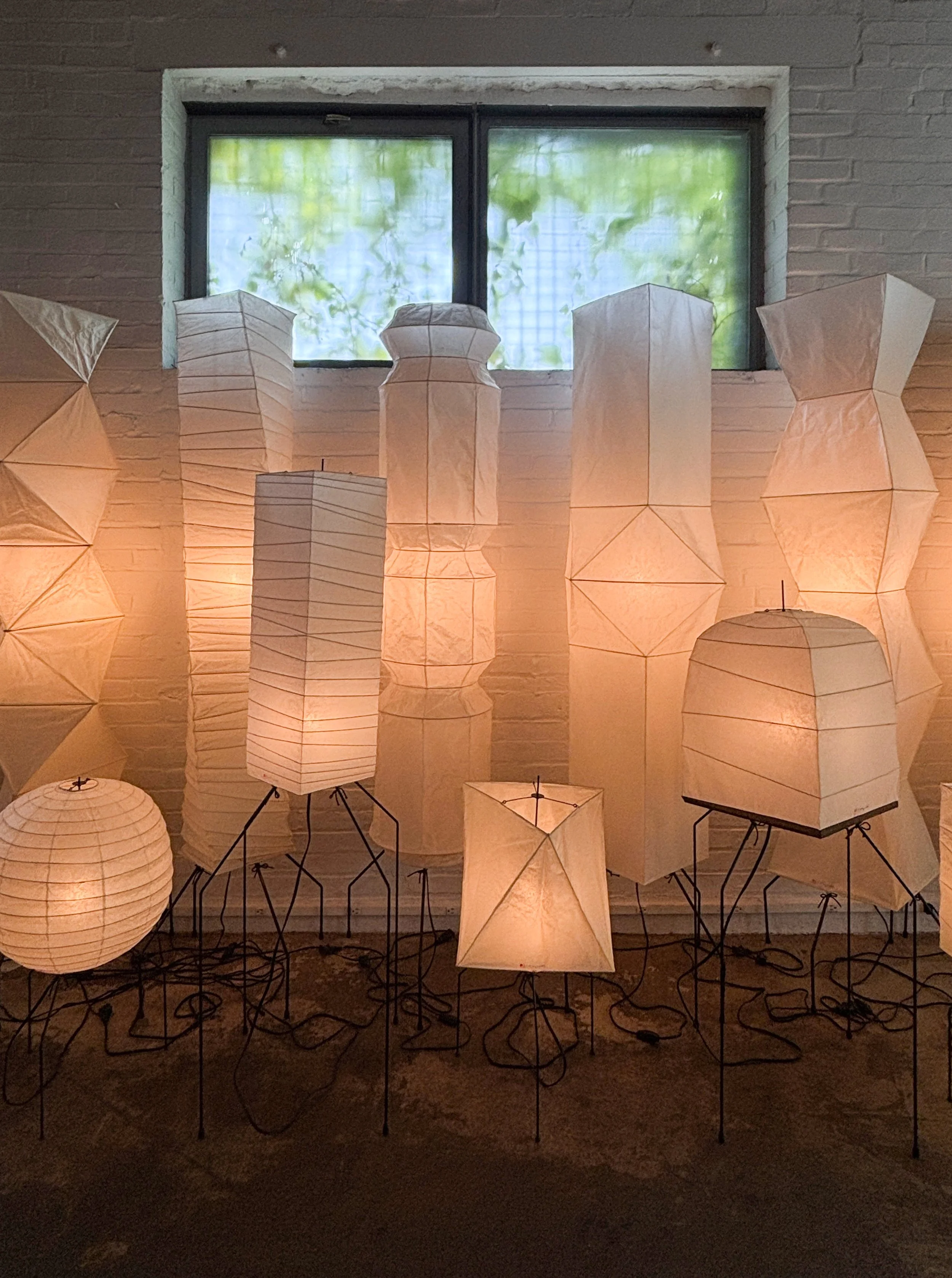
Akari Light Sculptures at the Noguchi Museum Shop, Astoria, New York.
These beautiful Akari Light Sculptures were designed by artist Isamu Noguchi (American, 1904–1988).
Already an established artist, Noguchi was 47 years old when he created his first Akari in the summer of 1951, after visiting Gifu, Japan. There, he encountered the traditional Gifu lantern-making craft and began exploring how this old technique could be transformed into something new.
Today, Ozeki & Co. (formerly Ozeki Jishichi Shoten), founded in 1891, continues to manufacture light sculptures in Gifu, using traditional lantern-making techniques and limited production.
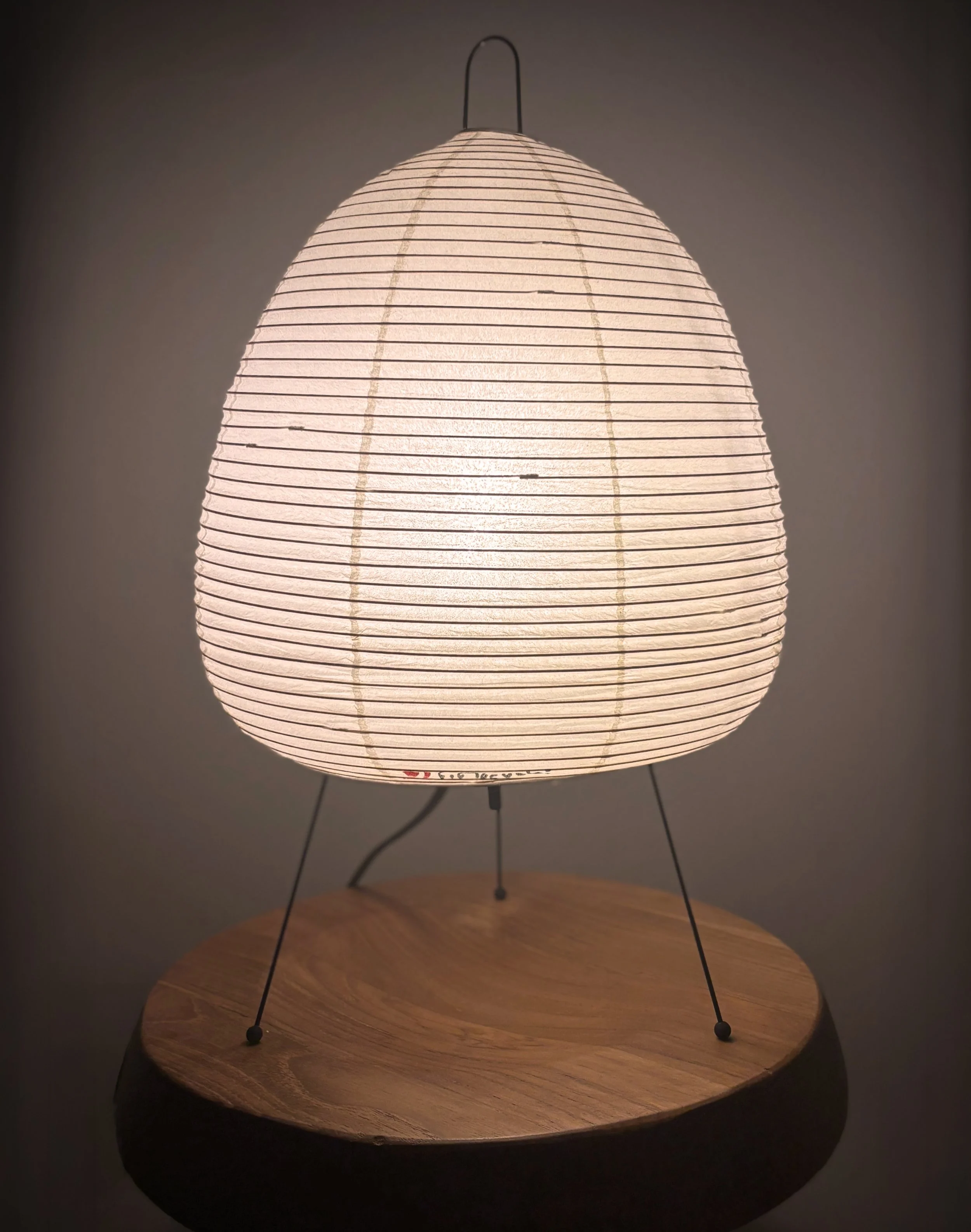
Contemporary Akari 1A. Designed by Isamu Noguchi and manufactured by Ozeki & Co., Gifu, Japan.
The shades are handmade using thin bamboo ribbing and washi paper. Long, continuous, dampened bamboo rods are strung, arranged, and sometimes spiraled over a wooden mold to create the form of the shade. Sheets of washi paper, traditionally made from the inner bark of the mulberry tree, are then glued over the bamboo framework and carefully trimmed to follow the shape created by the ribbing.
Once the paper has dried, the wooden mold is removed, leaving a lightweight paper shade that retains its sculptural form. The shades are designed to collapse, allowing them to be stored and transported flat. Steel wire armatures and an electrical socket are fitted inside to support the light bulb, transforming the traditional candle-lit Gifu lantern into a modern electric light.
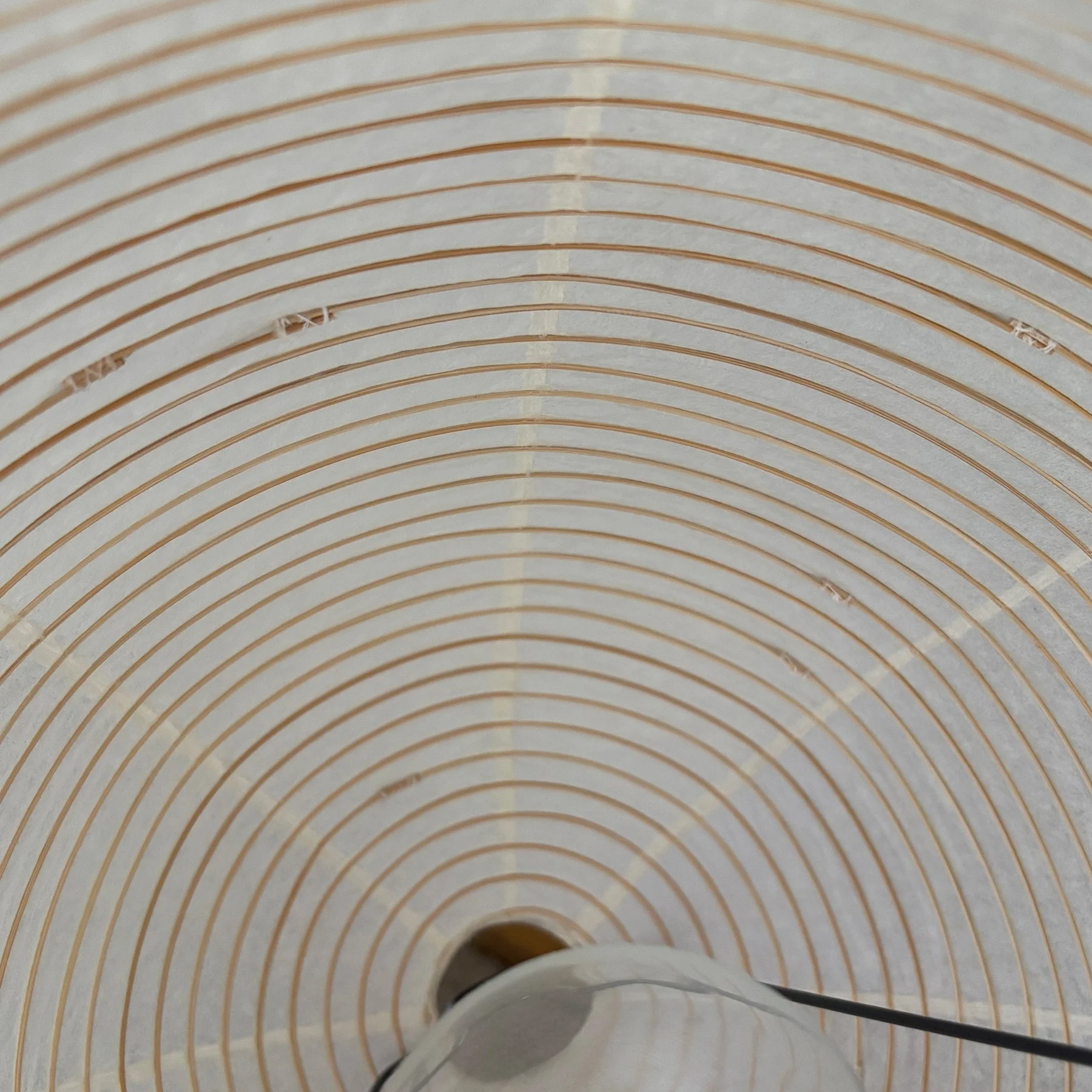
Inside a contemporary Akari 1A. The shade is handmade using thin bamboo ribbing, adhesive, and washi paper.
Noguchi named these ethereal objects Akari, a Japanese word meaning light or illumination.
In 1952, the Akari lamps were available for purchase in Japan. The same year, Noguchi presented the light sculptures at a major exhibition at the Museum of Modern Art in Kamakura, alongside the ceramics and sculpture that he created at Kitaoji Rosanjin’s Kamakura farmhouse. In December 1953, the Akari lamps were available for purchase for the first time at Bonniers, Inc., New York.
By the mid-1950s, Noguchi had created nearly 30 different Akari designs for tabletops, floors, and ceilings. The shades appeared in natural and painted washi papers, with some intentionally irregular forms that emphasized their sculptural character.
Noguchi continued to develop and modify the Akari series into the 1980s, ultimately adding more than 100 designs. The lamps brought together traditional Japanese craftsmanship and modernist design in a way that was both sophisticated and accessible.
Elegant. Sculptural. Modern. And, remarkably, attainable.
The beauty of Akari is also its vulnerability. Akari light sculptures are subject to inherent vice—the natural deterioration, fading, and weakening of the paper over time. Taking care of them and being mindful of your movements is part of the joy of owning them.
To prolong the life of an Akari, it should be used indoors and kept away from water, excessive heat, and outdoor conditions. Dust can be removed gently with a clean, soft, dry brush or microfiber cloth. Because the paper is delicate, it is best to avoid rubbing or applying cleaning products directly to the shade.
With so many reproductions, dupes, and secondhand examples being sold, sometimes with original packaging and sometimes without, how can you recognize an authentic Akari light sculpture?
One of the most important details to look for is the red sun and crescent moon emblem, based on the Japanese character 明, meaning “light” or “bright.” The emblem was trademarked in 1955 and became the identifying mark of the Akari series. Contemporary examples also bear the “I. Noguchi” signature. Light sculptures distributed in North America feature a “Japan” stamp.
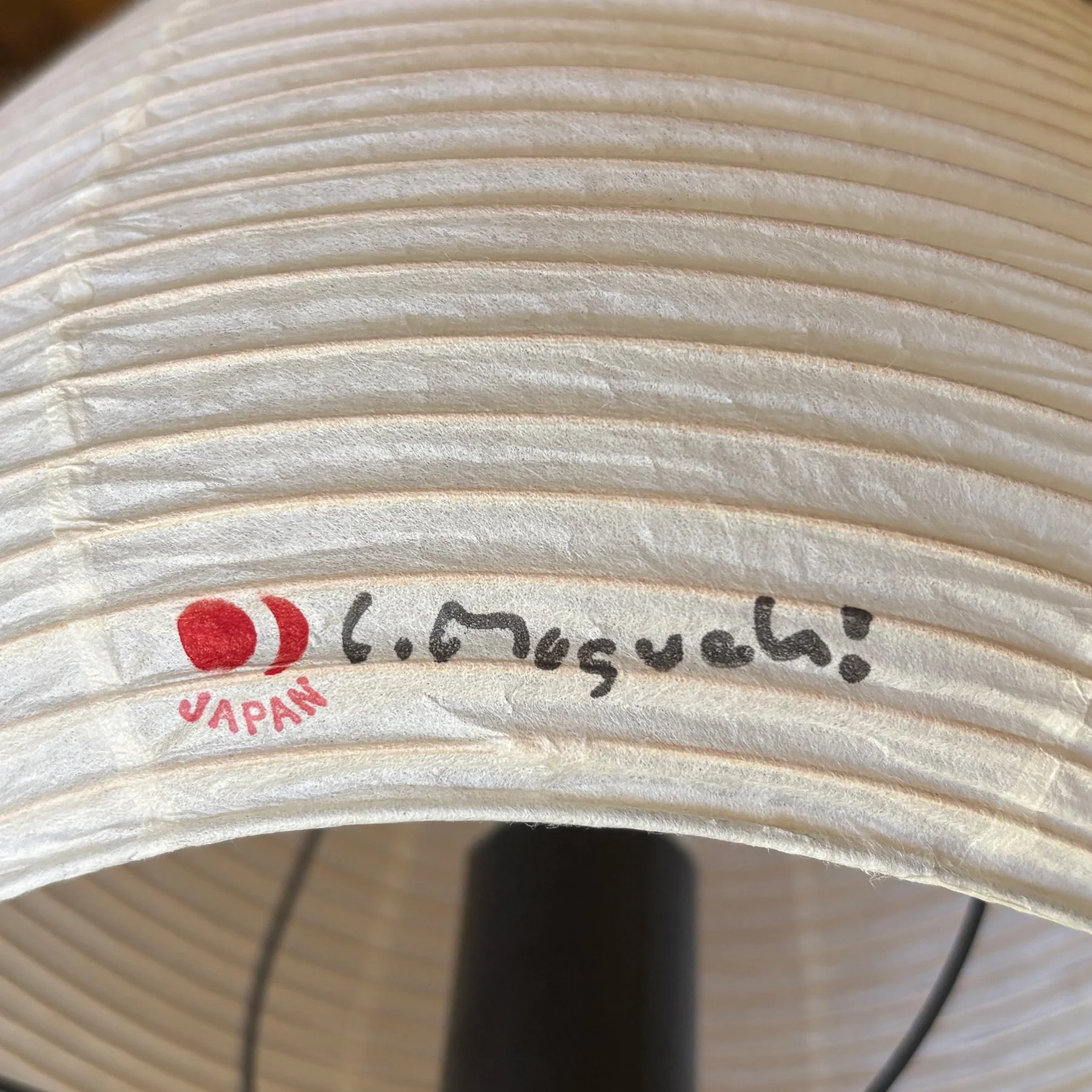
Red sun and crescent moon emblem, “Japan” stamp, and “I. Noguchi” signature on an authentic contemporary Akari 1A distributed in North America.
Akari light sculptures continue to be sold through the authorized distributors.
North America: Noguchi Museum, Astoria, New York
Japan: Ozeki & Co., Gifu
Europe, the Middle East, Australia, and New Zealand: Vitra
More than seven decades after Noguchi created his first Akari, these light sculptures remain a remarkable example of how traditional craft can be transformed through modern design and meet modern needs.
______________________________________________________________________________________
Sources
The Noguchi Museum. “The History of Akari Light Sculptures.” The Isamu Noguchi Foundation and Garden Museum.https://www.noguchi.org/isamu-noguchi/digital-features/the-history-of-akari-light-sculptures/?utm_source=chatgpt.com.
The Noguchi Museum. “Chronology.” The Isamu Noguchi Foundation and Garden Museum.https://www.noguchi.org/isamu-noguchi/biography/chronology/?utm_source=chatgpt.com.
The Noguchi Museum Shop. “Akari Light Sculptures.” The Isamu Noguchi Foundation and Garden Museum.https://shop.noguchi.org/collections/akari-light-sculptures?utm_source=chatgpt.com.
Vitra. “Akari Light Sculptures.” Vitra. https://www.vitra.com/en-un/product/akari-light-sculptures?utm_source=chatgpt.com.